
America’s Outdoor Recreation Economy Keeps Growing
The outdoor recreation economy has quietly become one of the most powerful forces in the U.S. economy — and new federal data shows it continues to grow even as inflation, supply chain disruptions, and shifting consumer budgets reshape spending.
According to new figures released by the U.S. Bureau of Economic Analysis, outdoor recreation generated $1.3 trillion in economic output in 2024, accounting for 2.4% of U.S. GDP and supporting 5.2 million American jobs. That represents 3.2% of all wage and salary employment nationwide. For industry leaders, the numbers confirm what many communities and businesses across the country already know: the outdoors has become a cornerstone of economic development, public health, and rural revitalization.
“Outdoor recreation is more than just fun—it fuels rural development and improves physical and mental well-being across the country,” said Christy LaCurelle, president & CEO, the Motorcycle Industry Council (MIC), the Specialty Vehicle Institute of America (SVIA), the Recreational Off-Highway Vehicle Association (ROHVA), and vice chair of the Outdoor Recreation Roundtable board. “Our Power Sports associations are working to ensure continued federal funding and authorization of the Recreational Trails Programs (RTP). This provides dedicated support for trial maintenance, development, and access nationwide. At the same time, we’re working with lawmakers and agency officials to protect riding opportunities on local and federal lands, mainly through thoughtful policy engagement, monitoring of legislation affecting off-highway vehicle use, and promotion of safety training and education”, added LaCurelle.
The BEA data shows several recreation categories leading the industry in economic value:
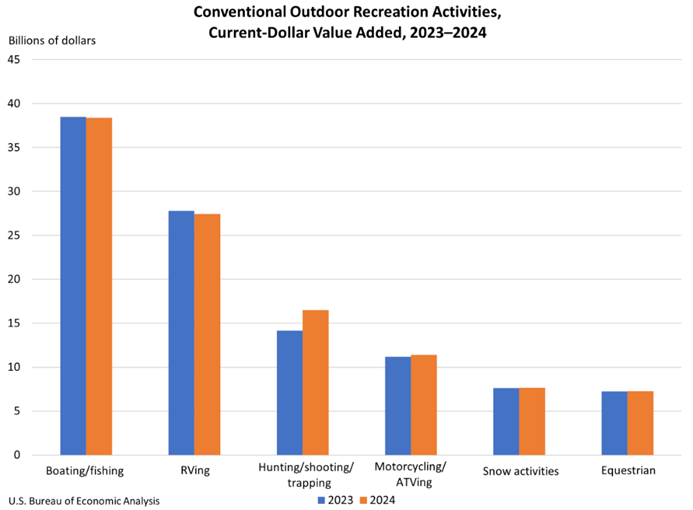
- Boating and fishing: $38.4 billion
- RVing: $27.5 billion
- Hunting, shooting, and trapping: $16.5 billion
- Motorcycling and ATV riding: $11.4 billion
- Climbing, hiking, and tent camping: $7.8 billion
Some of the fastest-growing activities included hunting and shooting sports, hiking and camping, and motorized recreation.
State economies continue to see major benefits, and according to the BEA data, the top outdoor recreation economies ranged from California at $87.9 billion in value added to Colorado at $18.1 billion. States including Massachusetts and North Dakota saw some of the fastest growth rates in 2024.
Outdoor recreation now accounts for significant shares of state economies in places like Alaska, Hawaii, and several Mountain West and New England states.
Since 2012, the outdoor recreation economy has expanded dramatically. BEA data shows the sector’s gross output has grown 84% over the past decade, rising from roughly $700 billion in 2012 to $1.3 trillion in 2024. Industry leaders say the numbers demonstrate that outdoor recreation is now firmly established as a cornerstone of the U.S. economy.
After SMUD Withdrawal, Coyote Creek Solar Fight Enters New Phase
The future of the proposed Coyote Creek Agrivoltaic Ranch Project remains uncertain — even after a recent major setback. During public testimony at the February 26 meeting of the California Off-Highway Motor Vehicle Recreation (OHMVR) Commission, the Sacramento Municipal Utility District (SMUD) confirmed it has cancelled its Power Purchase Agreement for the large-scale solar and battery storage facility planned east of Rancho Cordova. The project had been expected to generate enough electricity to power more than 44,000 homes. SMUD cited rising construction costs, supply chain challenges, environmental concerns, project delays, and ongoing litigation as reasons for stepping away. The decision represents a significant blow to the developer, as securing a buyer for the electricity is central to a project’s financial viability.
The proposal calls for thousands of acres of solar panels and battery storage along Scott Road near White Rock Road, an area that includes blue oak woodland, a creek corridor, and habitat that opponents say supports significant wildlife. Environmental advocates argue that removing mature trees and disturbing sensitive landscapes is unnecessary when alternative sites could accommodate renewable energy development with fewer impacts.
Don Amador, Western States representative for the Motorcycle Industry Council, credited the Commission’s actions and public deliberations with helping lay the groundwork that preceded, which included opposition by the California State Park Rangers Association and the filing of three lawsuits challenging the project. One of the litigants, the Environmental Council of Sacramento, which sued Sacramento County after it approved the project in November, said it will not withdraw its legal challenge. Amador’s remarks underscored how Commission engagement can catalyze broader institutional and legal responses when recreation, environmental, and public land concerns intersect. While SMUD’s withdrawal complicates the project’s path forward, it does not automatically terminate it.
The developer could seek another utility buyer, restructure financing, or attempt to use existing transmission infrastructure to deliver power elsewhere. That possibility is fueling continued vigilance among opponents, who worry that the project could reemerge under a different agreement.
The next phase will likely unfold in court. If the lawsuit succeeds, a judge could require additional environmental review or potentially overturn the county’s approval. If the developer fails to secure another buyer, financial realities could stall the project indefinitely. For now, the cancellation of the power agreement marks a turning point — but not a conclusion.
States Double Down on Outdoor Recreation as Economic Growth Strategy
Across the country, states are increasingly treating outdoor recreation not just as a lifestyle benefit, but as a serious economic policy. In recent weeks, the Offices of Outdoor Recreation and state leaders have hosted major summits, advocacy days, and industry gatherings to strengthen collaboration among policymakers, business owners, and community leaders. Events such as the Arkansas Governor’s Conference on Tourism and Outdoor Recreation, Utah Outdoor Recreation Day on the Hill, Maryland’s “Explore the Shore” Expo, New Mexico’s Tourism and Outdoor Recreation Day at the Capitol, Vermont Outdoor Recreation Day, and the West Virginia Outdoor Economy Summit reflect growing momentum behind the sector.
These meetings are part of a broader shift in how states are positioning outdoor recreation within their economic development strategies. Once viewed primarily as tourism promotion or leisure programming, outdoor recreation is now being framed as a long-term driver of rural development, workforce attraction, conservation funding, and public health. At many of the recent state events, discussions centered on infrastructure modernization, trail connectivity, marina upgrades, campground improvements, and expanding access to public lands and waterways.
Another emerging theme is the integration of outdoor recreation into public health planning. Research linking time outdoors to improved mental health and community resilience is influencing policy conversations in state capitols. As states convene stakeholders and sharpen their strategies, the message is consistent: outdoor recreation is no longer a secondary economic consideration. It is a core pillar of economic competitiveness and community resilience.